



Himalaya Harbinger, Rudrapur Burea
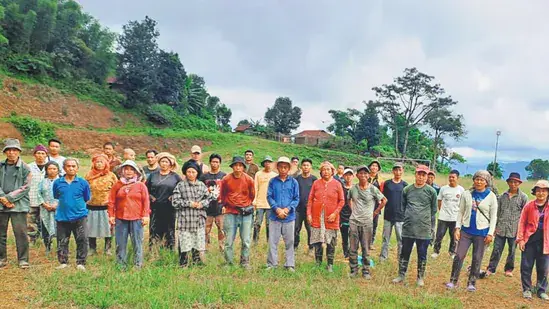
For the past five months, all 147 Naga residents of Konsakhul village in Manipur’s Kangpokpi district have rarely stepped outside their village because the only road out is through two Kuki-dominated settlements at a time when the state is being roiled by Naga-Kuki clashes that have killed at least 62 people.
On May 13, the last time a large group of residents left the village, 20 were abducted by villagers in Leilon Vaiphei, a nearby Kuki-dominated village, and handed over to militants, said Pyso Thiumei, whose family members were among those abducted. The bodies of six Naga residents were recovered by security forces more than a month later, on June 10
Had we been in a Naga district such as Senapati or Ukhrul, there would not have been this problem. We have been living here for generations and cannot abandon our land. Most people from our village have shifted to either Imphal valley, Naga districts or are living in relief camps, but around 150 of us here choose to stay back because Kukis will take over our land if we leave,” said village secretary Paorambou Chanwang.
The village –– dominated by farmers –– used to have around 550 residents. But now, only 147 are left.
Supplies of essential items are delivered weekly to this village of 76 households –– only 46 are inhabited now –– by a platoon of Central Reserve Police Force personnel, who have been stationed here since May 13.
On Sunday when HT visited the village, Chanwang Asha, 58, had just returned from a hospital after being admitted for a kidney stone problem a month ago.
“I was discharged three days ago, but it took time to coordinate with the village chief who was in touch with the CRPF team for the security. I had to be transported back to my village in a bullet proof car, which was escorted by the armoured Quick Reaction Team(QRT) vehicles for any ambush along the way,” Asha said.
We send a list of supplies needed every week to our Naga people living in Imphal (south of Kangpokpi) or in Senapati in the north. We manage to get basic vegetables and meat in the village, but for everything else, we depend on them. The head of the CRPF platoon informs us in advance when they are going down. Our people hand over the supplies, which the personnel transport through the Kuki villages and deliver at our gates,” village secretary Paorambou said.
This village became a focus because people were abducted from here, six of whom were killed. Along several highways, Central Armed Police Forces (CAPFs) are providing security convoys to transport fuel and other essential supplies for the entire state,” the official said, requesting anonymity.
The predicament of these villagers represents the larger turmoil in a state where tensions have simmered for over three years, slowly engulfing every community and dividing the province into ethnic enclaves separated by proto-borders. At least 300 have died since May 2023, when clashes first broke out between Kukis and Meiteis, and another 60,000 displaced.
The Naga-Kuki conflict first erupted on February 7 in Ukhrul over a drunken brawl on a village road that has left at least 62 people dead and more than 3,000 rendered homeless.
In the early days after the May 13 abduction, residents of nearby Kuki villages blocked roads to stop supplies from reaching Konsakhul. A CRPF officer, who was present at the spot at time of that blockade, said his colleagues told the villagers they were setting a dangerous precedent.
“The villagers had threatened to burn the supplies after stopping us. Our senior warned them then that if they don’t allow our vehicle, their supplies would be stopped too. We told them the vehicle had supplies for our platoon too. It was resolved and the problem has never occurred again.”
Pyso Thiumei, whose two brothers Dilip and Manu were among the six abducted and later murdered, chose to stay on.
“If you want to take a flight from Imphal, we have to first check if the bullet proof vehicle is available for transporting us, confirm that and then book the tickets no matter what the price of the ticket that day,” he said.
In Konsakhul, the men spend their day holding meetings and devising ways to guard the village, preparing a roster for volunteers to guard in the rear of the village, packed with hills and forests.
The CRPF guards the main entry to the village, preventing anyone from entering or leaving the village unauthorised. The CRPF guard, who has the village chief’s number, allows people only after getting a nod from the chief. Even after crossing the security barrier, Naga women volunteers guarding the village check for any outsider. Visitors are rare because the chances of outsiders being hit by sniper fire are high.
Mary Vaiphei, a resident of Leilon Vaiphei village, below Konsakhul, said security forces had conducted raids only in Kuki areas.
“Why don’t security forces conduct raids in Naga villages? They will find more weapons in Naga areas than in a militant camp. It is easy to defame Kuki villages. The security forces stationed above our village are also protecting us from the Naga people,” she said. “People also forget that all this is a result of Naga militants killing three Kuki pastors that same morning. Our village returned all the men, women and children we had abducted that day during the hostage exchange three days later. Those arrested by the NIA are all innocent. We continue to maintain that our village did not abduct the six men whose bodies were found.”
