





Himalaya Harbinger, Uttarakhand Bureau
New Delhi: The Public Works Department (PWD) has started work for the construction of a permanent foot overbridge (FOB) near the Rajputana Rifles headquarters along Ring Road, close to the make-shift “Bailey’s bridge” made after a report by HT highlighted how thousands of soldiers are forced negotiate a smelly culvert due to the absence of a safe crossing, officials aware of the development said on Thursday.
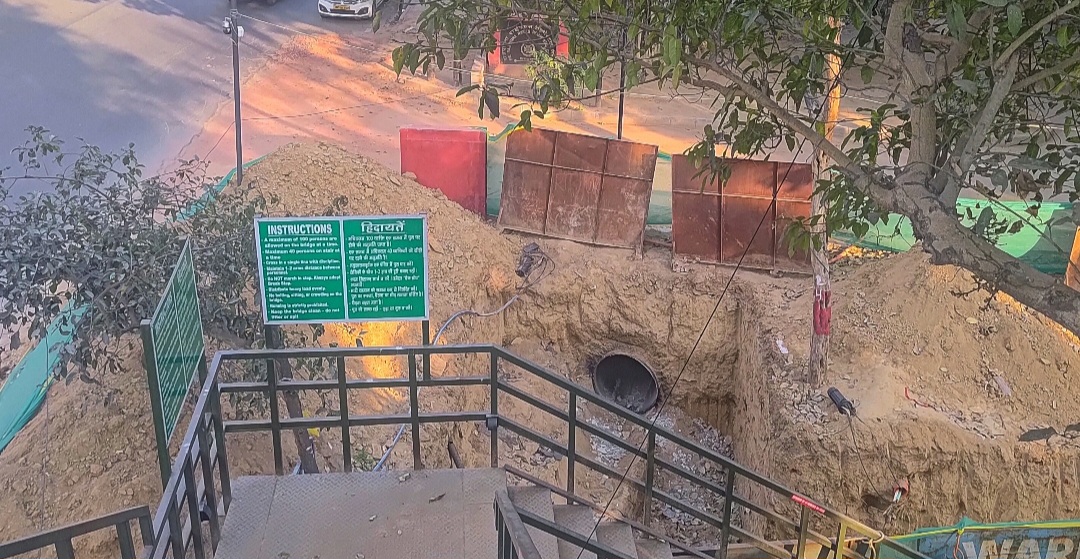
The project, which has been pending for over a decade, is expected to be completed within six months. Heavy machinery has been deployed and large trenches have been dug to lay the foundation for the structure.
The FOB being constructed will be a basic pedestrian bridge and will not have escalators or lifts.
Excavation and foundation work has started at the site adjacent to the Bailey’s bridge that was installed as a temporary measure last year. Once the foundation work is completed, we will start work on the main structure. Some traffic restrictions may be needed in a few months,” said an official.
The site falls near the Rajputana Rifles campus in Delhi Cantonment, where soldiers and trainees cross Ring Road daily to move between their barracks and training grounds. In the absence of a permanent FOB, they were earlier forced to cross a drain culvert located near the carriageway. The culvert, which carries. stormwater runoff, frequently overflows during the monsoon season, making the crossing difficult and unsafe.
In May last year, Hindustan Times had reported that soldiers of the Rajputana Rifles regiment were negotiating the culvert multiple times a day to reach their parade ground, despite the FOB having been approved years earlier.
On May 26, HT highlighted that thousands of soldiers of the regiment, one of the oldest rifle regiments of the Indian Army, crossed the culvert four times daily, twice before breakfast and twice after dusk, due to the absence of a safe pedestrian crossing.
During the monsoon, the situation worsened as the culvert filled with rainwater runoff. Trainees were either required to wade through waist-deep drain water or take a detour of more than 2.5 kilometres along Ring Road to cross from one side of the carriageway to the other.
Records accessed by HT showed that the FOB had earlier received approval in 2010. However, despite the clearance being granted nearly 15 years ago, the structure was never built and the project was eventually scrapped.
After HT’s report last year, the Delhi High Court took suo motu cognisance of the issue and directed the concerned agencies to ensure construction of the FOB. When the PWD informed the court that the permanent structure would take at least a year to complete, the court suggested the construction of a temporary Bailey’s bridge to provide immediate relief.
Acting on the suggestion, a Bailey’s bridge was erected within a fortnight and has been operational since October. With the commencement of foundation work this week, officials said the permanent FOB will now replace the temporary arrangement. Once the FOB is completed, the Bailey’s FOB bridge will be dismantled.
