





Himalaya Harbinger, Uttarakhand Bureau.
A one-day regional consultation-cum-workshop on large-scale natural farming was organized at Pantnagar Agricultural University in the Gandhi Hall. The event was jointly conducted by the Directorate of Extension Education and the National Centre for Organic and Natural Farming, Ministry of Agriculture & Farmers Welfare, Ghaziabad.
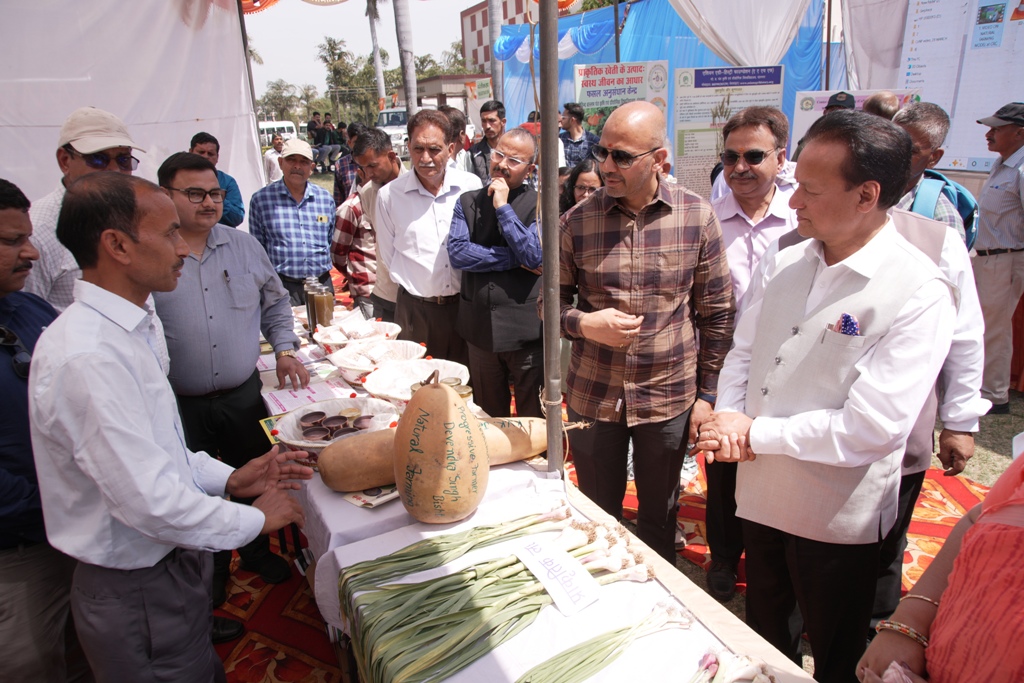
The workshop was graced by the Vice-Chancellor of the University, Professor Manmohan Singh Chauhan, as the Chief Guest. Special guests included Dr. Gagnesh Sharma, Director, National Centre for Organic and Natural Farming, Ghaziabad, and Dr. Lakshmikant, Director, Vivekananda Parvatiya Krishi Anusandhan Sansthan, Almora. Also present on the dais were Assistant Director Dr. Vachaspati Pandey, progressive farmer Dalchand, Dean of Agriculture Dr. Subhash Chandra, Director of Research Dr. S. K. Verma, and Professor Dr. Nirmala Bhatt from the Directorate of Extension Education. At the beginning of the workshop, the guests visited stalls set up by Krishi Vigyan Kendras and exhibitions on natural farming organized by Dr. Sunita T. Pandey at the Vrikshayurveda Natural Farming Centre.
In his presidential address, Vice-Chancellor Prof. Chauhan stated that the university’s alumni are contributing significantly both nationally and internationally, which is a matter of pride. Established in 1960, the university has been a leader in education and agricultural research. He emphasized the integration of scientific approaches with traditional knowledge. The participation of farmers, experts, and youth from different states reflects a promising future for agriculture. He highlighted that increasing farmers’ income, reducing cultivation costs, and conserving natural resources are the major challenges today. Considering the adverse effects of chemical farming, it is time to move towards balanced and natural farming. He stressed that self-reliance, scientific thinking, and sustainable agriculture are key to addressing future challenges. The university is committed to supporting farmers through training and guidance. He added that this workshop is not just an event but a collective mission aimed at achieving safe, sustainable, and profitable agriculture, contributing to a prosperous and self-reliant India by 2047.
Special guest Dr. Gagnesh Sharma noted that although the Green Revolution increased production through the use of chemical fertilizers and pesticides, it also led to a decline in soil fertility, organic carbon, and microbial activity, adversely affecting soil, water sources, and human health. Therefore, adopting organic and natural farming is essential. Resources like cow dung and cow urine improve soil quality and reduce costs. Due to rising input costs and limited availability of resources, natural farming has become a necessity for the future. Research centers are being established across the country, and the government is supporting farmers through the National Mission on Natural Farming. He advised farmers to start on a small scale and gradually transition to natural farming practices. He also highlighted that regions like Uttarakhand have favorable conditions for natural farming and stressed the importance of raising awareness among youth for a healthier lifestyle.
On this occasion, Dr. Lakshmikant discussed the practical aspects of natural farming and stated that agriculture today faces three major challenges: increasing farmers’ income, reducing input costs, and improving soil health. Soil is a living system, where microorganisms play a crucial role in maintaining crop productivity. Under the “One Health” concept, the health of humans, animals, the environment, and soil are interconnected. The imbalance in the use of chemical fertilizers has affected soil quality. While fertilizers are beneficial in the right quantity, excessive use is harmful. He emphasized the need to focus not only on food security but also on nutritional security. Balanced use of organic and chemical fertilizers can ensure better production and soil health. He also highlighted that branding and certification can help farmers fetch better prices for their produce. For successful natural and sustainable farming, three pillars are essential: scientific research, farmers’ participation, and government support.
Progressive farmer Dalchand shared his experiences, stating that adopting natural farming has reduced his production costs and improved crop quality. He encouraged other farmers to adopt this method and shared details of his experiments in the field.
At the beginning of the workshop, Director of Extension Education Dr. Jitendra Kwatra welcomed the participants and presented the outline of the program. During the event, a Natural Farming Awareness Calendar and a book on natural farming were released by the dignitaries. Discussions were held among progressive farmers and experts on various aspects of natural farming. Scientific insights based on research conducted at Pantnagar University were also shared. A question-and-answer session was organized for participants, where experts addressed farmers’ queries.
The workshop concluded with a vote of thanks by Dr. Nirmala Bhatt. A large number of farmers, stakeholders, students, scientists, deans, directors, and faculty members were present. Approximately 800 farmers from different districts of Uttarakhand participated in the workshop.
