
Himalaya Harbinger, Rudrapur Burea
The Commission for Air Quality Management (CAQM) has restricted outdoor construction and demolition work that raises dust across the National Capital Region (NCR) from November 5 to 20, a window that spans Diwali and what is typically the season’s worst stubble burning impact, extending the curbs to highways, roads and other linear public projects.
The order covers work on flyovers, overbridges, power transmission lines, pipelines and telecommunication works as well, although it exempts projects related to railways, metro services, airports, inter-state bus terminals, hospitals, water supply and sanitation, and national security and defence, along with projects of national importance.
Work from home, C&D activities curb
Union environment minister Bhupender Yadav announced the curbs on Friday as part of the Centre’s efforts to control air pollution in the region. CAQM notified them late on Friday in an order that applies across the NCR, including Delhi, and directs the NCR state governments and the Delhi government to enforce it. The window covers Diwali, on November 8, and the first two weeks of November, when stubble burning and its impact on Delhi have historically peaked.
The order also requires state government and private offices in Delhi and in Ghaziabad, Gurugram, Faridabad, Sonipat and Gautam Buddha Nagar to have no more than half their staff attend in person, with the rest working from home, except in industrial establishments and essential services where this is not feasible. Delhi’s winter framework separately mandates 50% work from home in government and private offices from November 1.
The order exempts industrial establishments and essential services where working from home is not feasible.
Acting pre-emptively
The curbs add to Delhi’s own ban on construction and demolition from November 1 to January 31, which tightens into a “stricter” ban on all C&D activities from December 10, 2026 to January 20, 2027.
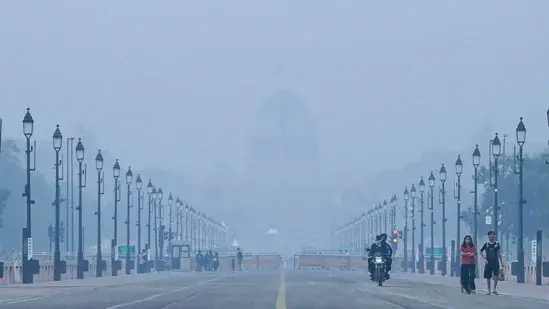
CAQM said a combination of factors tends to make this a highly polluted window: emissions from local sources, seasonal burning of crop residue and biomass, and other episodic events. “At the same time…adverse meteorological conditions, including low wind speeds, a shallow atmospheric boundary layer and reduced vertical mixing, further limit pollutant dispersion…” CAQM said in the order.
The proposed measures are preventive in nature, limited to a specified period and geographical area and have been formulated, keeping in view, the seasonal vulnerability of the region,” it said, adding that the exemptions for essential public infrastructure, national security and other critical services are meant to ensure that essential and unavoidable activities are not disrupted.
“The decision has been taken as a preventive step by CAQM, as it looked at past data and found conditions are typically adverse during this window,” Yadav told the media.
Sunil Dahiya, founder and lead analyst at Envirocatalysts, said that despite the many exemptions, the curbs were a good start for the Centre and states in acting pre-emptively. “From June itself, we are seeing restrictions being announced in advance, including this one. Earlier, we would see Grap restrictions coming when the pollution is already at its peak. Though a good start, we can target even more sectors,” Dahiya said.
PAVAN-I3C, which operates on the principle of ‘Detect, Analyse, Act’, brings together information on air quality, emissions, weather, satellite imagery, traffic, public complaints and compliance. The platform draws data from 111 continuous ambient air quality monitoring stations across Delhi-NCR, over 2,300 industries and more than 3,200 active construction sites. Deviations from prescribed norms and statutory directions will trigger alerts and escalation to the concerned agencies.
“Clean air cannot be secured by any one agency or any one State acting alone. The I3C brings every data stream that matters onto a single screen, so that a farm fire, a polluting stack or an uncovered construction site is seen, flagged and acted upon in real time. This is a paradigm shift from reacting to pollution to anticipating it, and every implementing agency must now act in real-time on these alerts without delay,” Yadav said.
